On the morning of June 6, 2025, the 12th lecture of the "Two Integration" Lecture Hall of the School of Marxism at Nanjing University was held at the Yifu Teaching Building in Xianlin Campus. This lecture has invited Professor Wen Rui, Chief Professor and Doctoral Supervisor of Jiangxi University of Finance and Economics, to give a special lecture on "Several Issues Concerning Property Protection and Contractual Spirit in China". Mr. Wen is mainly engaged in research in the fields of Chinese farmers' issues, land system, and property protection. His first monograph, "Research on the Land Revolution in the Central Soviet Area," was translated into English in the United States. The lecture was hosted by Professor You Haihua from our university.
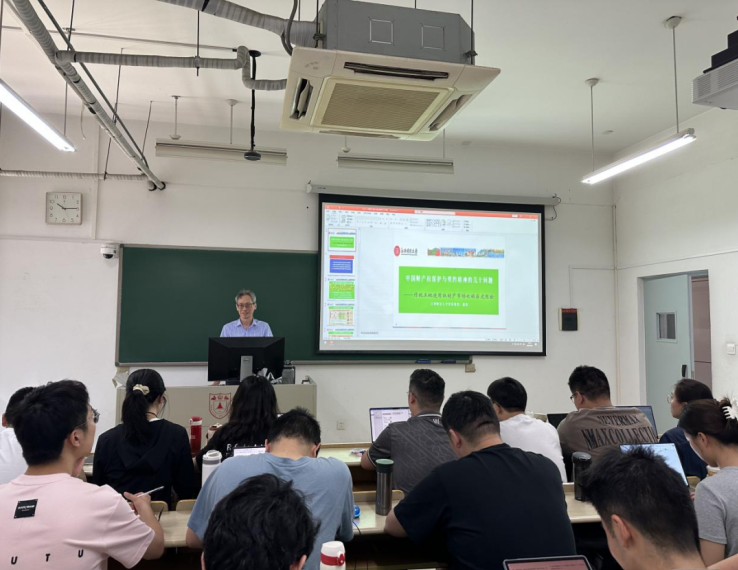
At the beginning of the lecture, Mr. Wen led the students to trace the historical origin of land use rights in China, with the introduction of the current credibility crisis in China and the academic circles' problems such as the Chinese people's lack of market property rights and contractual spirit tradition. Teacher Wen believes that since the Jingtian system of the Western Zhou Dynasty, traditional Chinese land rights have included a two-tier shared and coexisting structure of "government land management rights" and "public land use rights". Later, through the Jingtian system reform in the Spring and Autumn and Warring States periods, land use rights were granted, and the Han Dynasty practiced perpetuity. Gradually, agricultural, industrial, and commercial subjects gained stable land use rights and income rights, thus forming the economic and institutional foundation derived from market property rights and contract culture. Teacher Wen mentioned that this system is in line with human civilization, forming the five major market rights views of agricultural, industrial and commercial subjects from grassroots markets, and developing a mature and rich market contract culture. At the same time, this "credit based" and contractual spirit rooted in the grassroots mass market is not only a key guarantee for the effective operation of traditional markets, but also a historical and cultural gene and public foundation for the construction of modern Chinese rule of law and the protection of private property.
After sorting out the historical context, Teacher Wen pointed out that the property protection and contract culture in traditional China were still restricted by imperial autocracy in their historical development. The concept of "imperial supremacy" fundamentally denies the independent property rights subject status of the subjects; The characteristics of monopoly, privileged monopoly, and arbitrary power not only undermine market rules, but also squeeze the development space of the private economy, resulting in the contract spirit and market rights concept rooted in the grassroots mass market being influenced by "hidden rules", which has long hindered the cultivation of national legal awareness. The traditional market contract spirit, which was once castrated by power, has been restored and rebuilt with the rule of law through modern economic system reforms.
On the basis of summarizing the historical experience of China's land use right system and private property protection in the past 3000 years, Professor Wen focused on the current economic reform in China and introduced to the students the main practices and four understandings of China's land use right, deepening market economy reform, and protecting property rights.
During the interactive questioning session, students sought advice from Teacher Wen on recent issues such as the "separation of powers" reform and the Property Protection Law. Teacher Wen provided specific and detailed answers one by one, and further elaborated on his own understanding and views.
Finally, Teacher You Haihua shared his feelings and experiences with everyone, believing that Teacher Wen has high-level abilities in rooting historical materials, tracing historical origins, and applying methods, bringing a rich and exciting intellectual feast to all students. At the same time, Professor Wen also encourages all students to pay attention to the issue of rural farmers in China and to solidly devote academic research to the land of China.
END

 Friendship link